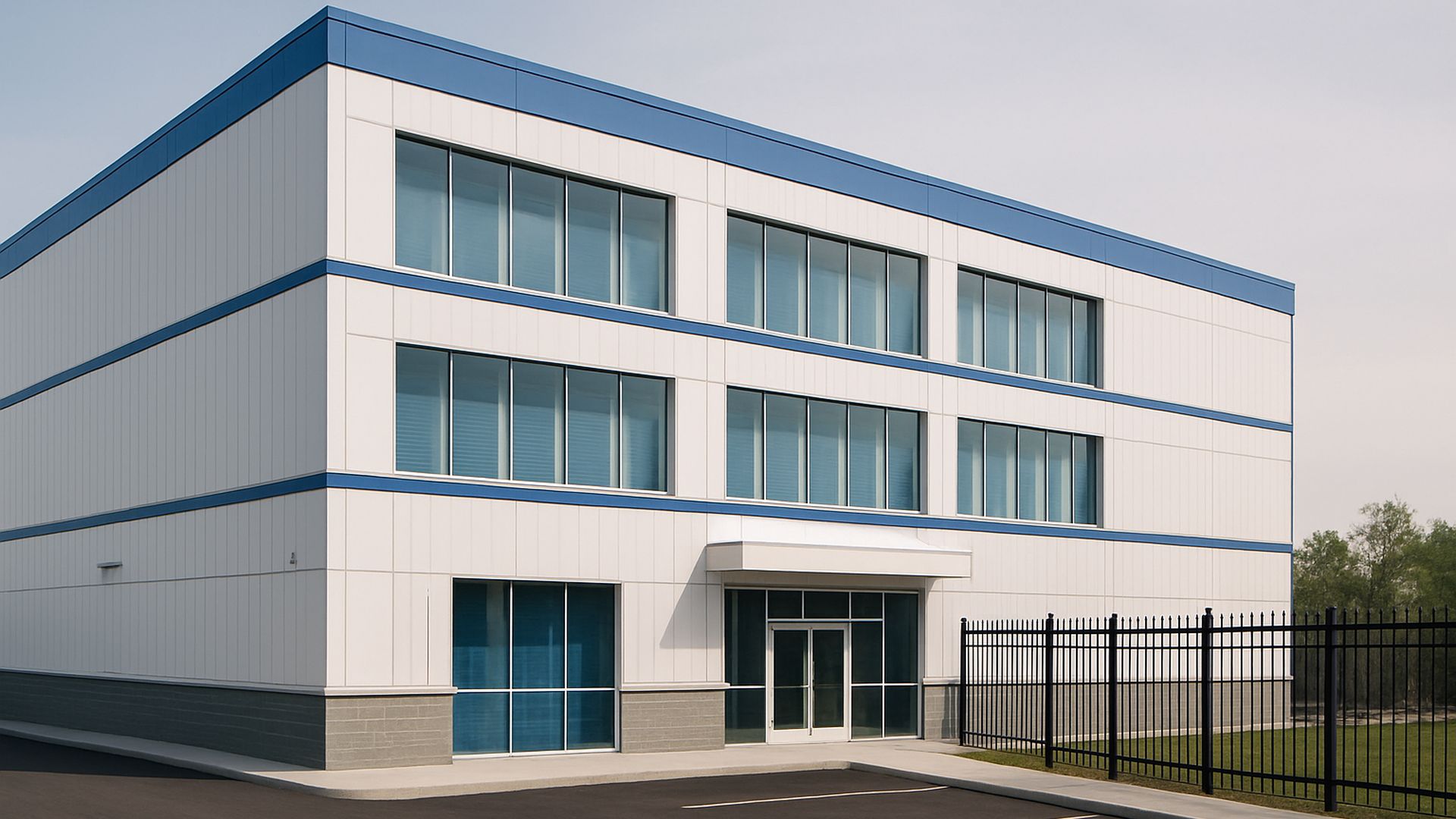
Cost Segregation for Self-Storage Properties
Self-storage produces one of the highest accelerated reclassification ratios in commercial real estate. The structure is light (prefabricated metal panel buildings on slab); much of the property value sits in components that classify as 5-year or 15-year. Climate-controlled multi-story facilities reclassify lower than single-story drive-up facilities because more of the build is structural (elevators, HVAC, second-floor structure), but both formats clear 30% accelerated comfortably.
Note: Industry-benchmark grounding. Self-storage is not currently modeled as a standalone property type in the Cost Seg Smart engine. The figures below reflect published industry benchmarks and the IRS Cost Segregation Audit Techniques Guide. Cost Seg Smart’s engineering team produces self-storage studies using commercial methodology with self-storage-specific component weighting; engineering numbers per property are produced at study time.
Reclass benchmark for self-storage
Industry-source reclass benchmarks across self-storage formats:
| Facility format | Typical accelerated reclass | Source |
|---|---|---|
| Single-story drive-up (older format) | 30–36% | Self Storage Association reports; published study aggregations |
| Single-story climate-controlled | 32–38% | Self Storage Association reports |
| Multi-story climate-controlled | 28–34% | Published study aggregations |
| Mixed-format (climate + drive-up) | 31–37% | Blended |
The typical bucket composition for a single-story climate-controlled facility:
| Bucket | Median % of basis |
|---|---|
| 5-year (Section 1245 personal property) | 8–14% |
| 7-year (Section 1245 specialty) | 1–2% |
| 15-year (Section 1250 land improvements) | 18–24% |
| 39-year (Section 1250 structural) | 60–73% |
Self-storage is the property type where the 15-year bucket is the largest accelerated bucket. Paving (driveways, customer access, RV/boat storage areas), site lighting, fencing, gates, and exterior security infrastructure are all 15-year. The 5-year bucket is smaller than office or retail because self-storage interiors have minimal finish.
What gets reclassified in a self-storage property
5-year personal property (Section 1245):
- Security gates with electronic access control (the gate operator system is 5-year; the gate structure is 15-year)
- CCTV and surveillance equipment
- Office and rental-counter FF&E (small percentage of property)
- Specialty HVAC for climate-controlled units (when separable from base building)
- Roll-up storage unit doors (this is the area of largest classification dispute; many CPAs and engineering firms classify the unit doors as 5-year personal property under the permanence test)
- Interior signage, wayfinding
- Property-management software and IT infrastructure
7-year specialty (Section 1245):
- Built-in office casework (limited)
- Specialty management-office fixtures
15-year land improvements (Section 1250):
- Asphalt drive lanes and customer access paving (largest 15-year line)
- RV / boat / vehicle storage paving
- Site lighting (drive-aisle lighting, perimeter lighting)
- Perimeter fencing and security walls
- Monument signage
- Landscaping (minimal in most facilities but present at branded chains)
- Storm drainage, retention areas
- Curbing, wheel stops
39-year structural (Section 1250):
- Building shell (metal panels, structural columns, roof structure)
- Slab on grade
- Permanent partition walls (interior corridors in multi-story)
- Base building HVAC (for offices and common areas)
- Elevators (multi-story facilities, always 39-year)
- Structural electrical service entrance
- Permanent fire suppression infrastructure
The roll-up door classification is the most consequential single decision in a self-storage study. The engineered methodology defends 5-year classification under the Treasury Regulation 1.48-1(c) permanence test (doors are removable without damage), supported by industry practice and the IRS ATG framework.
Engineered analyses of self-storage properties
Three representative scenarios, with figures reflecting industry-source typical reclass percentages applied to representative basis levels:
- Small scope — single-story climate-controlled, Tampa FL — 35,000 SF rentable, $2.1M acquisition. Typical year-1 federal savings range: $200K–$255K.
- Mid scope — single-story climate facility, Dallas TX — 75,000 SF rentable, $6.8M acquisition. Typical year-1 federal savings range: $650K–$830K.
- Large scope — three-story climate-controlled, Denver CO — 145,000 SF rentable, $14M acquisition. Typical year-1 federal savings range: $1.2M–$1.5M.
All three reflect industry-benchmark ranges. The Cost Seg Smart engineering team produces a facility-specific engineered analysis at study time; per-property numbers will differ from the typical-range estimates.
Audit considerations for self-storage
The IRS examines self-storage studies on these axes:
-
Roll-up door classification: The single most consequential audit question in a self-storage study. The engineering position is that storage unit doors are 5-year personal property — they are removable without damage to the structural opening, they serve the tenant’s use of the rented space, and they meet the permanence test. The documentation must support this with photographs showing the mounting and detail on the removability.
-
Office buildout vs storage buildout: The rental office is a small portion of the building but has higher 5-year density (carpet, office buildout, computer infrastructure). The audit will look at the square-footage split and the cost allocation between office and storage portions.
-
Climate control HVAC: HVAC dedicated to climate-controlled units may qualify 5-year if it’s a separable system from the base building. HVAC serving the office and common areas is 39-year. The engineering schedule must distinguish.
-
Security gate and access control: The physical gate structure is 15-year (a site improvement). The gate operator, access control system, and software is 5-year. The component schedule must separate.
-
Drive aisle paving: The drive aisles serving customers are 15-year. The audit will verify the cost allocation against site work line items.
-
RV / boat / vehicle storage areas: Paved exterior storage areas are 15-year land improvement. Covered storage with light roof structure may classify partly as 15-year (the slab and paving) and partly 39-year (the roof structure).
How a self-storage study is conducted
The engineered methodology applies six steps tailored to self-storage:
- Property scoping: facility format (single-story drive-up / single-story climate / multi-story / mixed), rentable square footage, year built
- Land valuation: county assessor record where reliable; statistical metro/state ratios otherwise — self-storage often has higher land share than other commercial
- Component inventory: building shell, unit doors, drive aisles, security infrastructure, office buildout, RV storage if applicable, signage
- Cost allocation: RSMeans 2024 + PPI time index applied per component, with self-storage-specific weighting
- Classification: each component to its MACRS bucket under Section 168, with defended position on roll-up door classification
- Reconciliation: total reconciles to depreciable basis to the penny
FAQ
How much does a self-storage cost segregation study cost?
Self-storage studies typically range $2,500–$10,000. A small single-story facility sits at the low end; a large multi-story climate-controlled facility at the upper end. Multi-format facilities (climate + drive-up + RV) increase the engineering complexity.
Does cost segregation work for an REIT-owned self-storage property?
Yes. Self-storage REITs (Public Storage, Extra Space, CubeSmart, Life Storage) perform cost segregation routinely on acquired and developed properties. The accelerated depreciation reduces the property’s tax basis the same way as for non-REIT owners; the REIT distribution rules are what the REIT’s tax counsel manages.
What about a self-storage facility I just bought?
The acquired property’s full depreciable basis (purchase price less land) is the starting point. Engineered analysis identifies the accelerated buckets immediately. Cost segregation on an acquisition produces the largest year-1 benefit because of the 100% bonus depreciation under OBBBA (2025).
Does cost segregation make sense for a small single-story facility?
At $2.1M basis for a 35,000 SF facility (the small-scope analysis above), the typical reclass produces $540K–$690K of accelerated bucket components, generating $200K–$255K in year-1 federal savings at a 37% bracket. After a $3,000–$5,000 study fee, year-1 ROI is 40–80×.
What if I’m developing a new self-storage facility?
A pre-construction cost segregation review identifies optimal classification of planned components, so the construction accounting maps directly to the depreciation schedule. Particularly valuable for facilities with climate-controlled portions, where the HVAC classification questions carry the most weight.
How does cost segregation interact with self-storage roll-up structures?
The “roll-up structure” reference here is the corporate acquisition vehicle, not the storage unit door. Cost segregation works the same way regardless of the acquisition vehicle. The property entity captures the depreciation; the parent’s tax position determines how the deduction flows.
What about self-storage with retail box conversion?
Many newer urban self-storage facilities are conversions of former big-box retail (Kmart, Walmart, etc.). The conversion typically generates substantial accelerated depreciation in the renovation work itself, on top of the building’s reclassification.
Are there self-storage properties where cost segregation doesn’t help?
Properties under $400K basis or with very short expected hold periods (under 24 months) may not produce returns justifying the study fee. Single-tenant industrial outdoor storage facilities (no buildings, just paved storage yard) have all the value in 15-year buckets — they still benefit from cost segregation because the 15-year bucket alone qualifies for 100% bonus depreciation.
Get an engineered analysis of your self-storage property
Cost Seg Smart produces engineered self-storage analyses across single-story drive-up, climate-controlled, multi-story, and mixed-format facilities. Schedule a 15-minute scoping call to discuss your property.