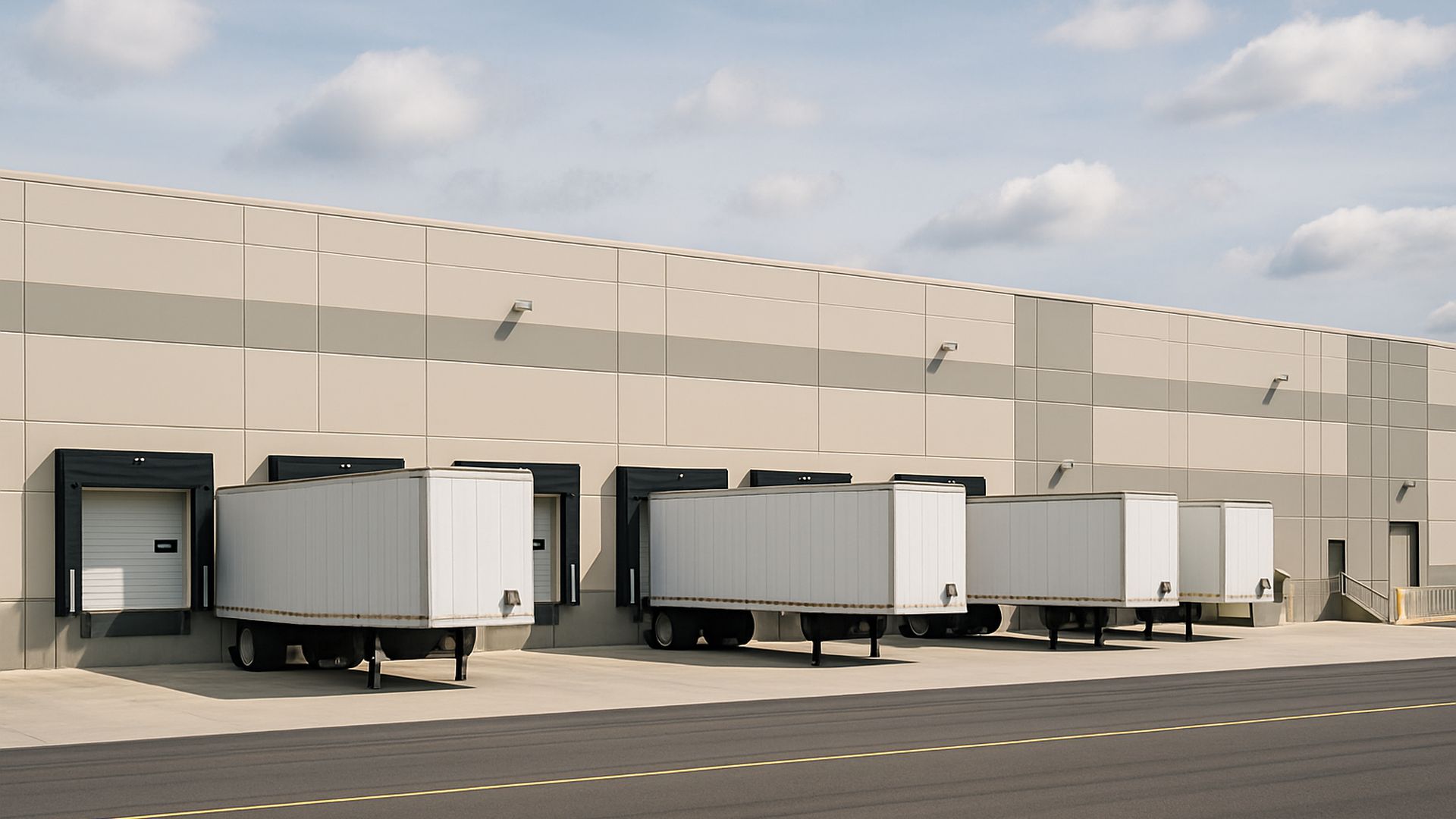
Cost Segregation for Industrial Properties
Industrial has the widest variance of any commercial property type. The reclass percentage depends heavily on subtype: pure warehouse with minimal office finish reclassifies in the high teens, flex bay industrial with moderate office reclassifies in the mid-20s, and heavily-improved industrial-office or specialty manufacturing reclassifies into the low 30s. The Cost Seg Smart engine uses a finish-density classifier to set the correct weighting per property — applying flex-bay weights to a pure warehouse would overstate, and vice versa.
Reclass benchmark for industrial
Across the Cost Seg Smart engineered analysis dataset, industrial properties reclassify a median of 20.7% of the depreciable basis into accelerated buckets. The IQR is wide — 18–30% — reflecting the subtype variance.
| Bucket | Median % of basis |
|---|---|
| 5-year (Section 1245 personal property) | 6.9% |
| 7-year (Section 1245 specialty) | 0.7% |
| 15-year (Section 1250 land improvements) | 13.1% |
| 39-year (Section 1250 structural) | 79.3% |
Note the distinct pattern: the 15-year bucket is larger than the 5-year bucket. Industrial properties carry large parking and site improvements (truck courts, drive lanes, fenced storage yards) relative to their interior finish density. This is the opposite of medical office or restaurant.
What gets reclassified in an industrial property
5-year personal property (Section 1245):
- Office buildout within the industrial building (carpet, partitions, dedicated HVAC)
- Specialty MEP for industrial operations (compressed air systems, dust collection, specialty exhaust)
- Production-specific equipment mounts and electrical
- Decorative interior finishes in office areas
- Specialty lighting in office areas
- Specialty plumbing for industrial operations (process water, eye-wash stations, deluge showers)
- Dock equipment that’s interior (dock seals, shelters considered building component vs. equipment varies)
- Building security and CCTV systems
7-year specialty (Section 1245):
- Built-in office casework, reception desks (limited categories in industrial)
15-year land improvements (Section 1250):
- Truck court paving — the largest 15-year line in most industrial properties
- Trailer parking and storage yard paving
- Fenced and gated yard, perimeter security
- Site lighting (yard lighting, loading dock lighting)
- Monument signs, building-mounted signage
- Storm drainage, retention areas
- Rail siding access (where applicable)
- Concrete pads for exterior tanks, generators, transformers
39-year structural (Section 1250):
- Building shell, structural steel, roof, foundation
- Slab on grade (industrial slab is typically 39-year unless reinforced for specific equipment)
- Base building HVAC (typically minimal in pure warehouse)
- Structural plumbing and electrical service
- Loading dock structural components (door tracks, levelers in some classifications)
- Permanent fire suppression infrastructure
The engine’s finish-density classifier separates pure warehouse (under 5% office finish) from flex bay (10–20% office) from industrial-office (over 25% office), and applies different component weights accordingly. A 425,000 SF distribution center with 8,000 SF of office reclassifies very differently than a 110,000 SF flex bay with 35,000 SF of office.
Engineered analyses of industrial properties
Three representative analyses from the Cost Seg Smart engine:
- Small scope — older warehouse, Bensalem PA — 25,000 SF, $1.8M acquisition, 1985. Year-1 federal savings at 37%: $115,560.
- Mid scope — flex bay industrial, Houston TX — 110,000 SF, $9.5M acquisition. Year-1 federal savings: $648,793.
- Large scope — modern distribution center, Columbus OH — 425,000 SF, $32M acquisition. Year-1 federal savings: $2,138,843.
All three assume 100% bonus depreciation (OBBBA 2025), top federal bracket, and accelerated buckets taken fully in year 1.
Audit considerations for industrial
The IRS examines industrial studies on these axes:
-
Office vs warehouse split: The office portion of an industrial building reclassifies very differently than the warehouse portion. The engineering documentation must establish square footage for each and apply component weights separately.
-
Slab classification: Standard industrial slab on grade is 39-year structural. Reinforced slab for specific equipment loads (heavy machinery, racking systems anchored to slab) may qualify accelerated as a “secondary use” of the building. The structural engineering documents resolve it.
-
Truck court paving: The truck court is 15-year land improvement. The audit will verify the cost allocation against site work line items.
-
Loading dock components: Dock doors, dock seals, dock levelers, and dock bumpers fall in different MACRS classifications. Dock equipment is typically 5-year; structural dock components are 39-year. The engineering schedule must distinguish.
-
Specialty MEP: Compressed air systems, dust collection, process water, specialty exhaust — each is 5-year personal property when serving the industrial operation. The piping schedule and cost allocation must defend the classification.
How an industrial study is conducted
The engineered methodology applies six steps tailored to industrial:
- Property scoping: subtype classification (pure warehouse / flex bay / industrial-office / specialty), office/warehouse square footage split, year built, era profile
- Land valuation: county assessor record where reliable; statistical metro/state ratios otherwise — typically a higher land share for industrial than other commercial
- Component inventory: separate inventory for office and warehouse portions, specialty MEP, exterior site (truck court, fenced yard, rail siding where applicable)
- Cost allocation: RSMeans 2024 + PPI time index, with subtype-specific finish density weighting
- Classification: each component to its MACRS bucket under Section 168
- Reconciliation: total reconciles to depreciable basis to the penny
FAQ
How much does an industrial cost segregation study cost?
Industrial studies typically range $2,500–$12,000. Pure warehouse with minimal finish sits at the low end (less component complexity); large modern distribution centers with extensive truck court and specialty MEP at the upper end.
Does cost segregation work for a pure warehouse?
Yes, but the reclass percentage is lower than other commercial property types — typically high teens to low 20s. The 15-year bucket (truck court, exterior site) still produces material benefit. At $1.8M basis for a 1985 warehouse, the engineered study above identifies $312,323 in accelerated buckets — still a 30× year-1 ROI after the study fee.
What about industrial outdoor storage (IOS)?
IOS properties — fenced trailer parking, container storage yards, equipment lots — are dominated by 15-year land improvements (paving, fencing, lighting). Reclass percentages depend on how much building is on the property. A pure IOS with no buildings still qualifies for cost segregation on the site improvements.
Does cost segregation work for owner-occupied industrial?
Yes — the property owner captures depreciation regardless of whether the occupant is the same entity. Owner-operators often own the real estate through a separate LLC for liability and tax reasons.
What if I’m building a distribution center?
A pre-construction cost segregation review identifies optimal classification of planned components, so the construction accounting maps directly to the depreciation schedule. Particularly valuable for large modern distribution centers where the component count is high.
How does cost segregation interact with bonus depreciation on industrial?
The accelerated buckets (5-year, 7-year, 15-year) qualify for 100% bonus depreciation under the OBBBA (2025). The 39-year structural bucket does not. The bigger the accelerated buckets the engine identifies, the bigger the bonus depreciation deduction.
What about industrial properties with rail siding?
Rail siding is typically 15-year land improvement when on the property. Off-site rail connections owned by the railroad are not in the basis at all.
Are there industrial property types where cost segregation doesn’t help?
Properties under $400K basis or with very short expected holds (under 24 months) may not produce returns that justify the study fee. The engineered analysis is most productive at $500K basis and above with a 3+ year hold.
Get an engineered analysis of your industrial property
Cost Seg Smart produces engineered industrial analyses across pure warehouse, flex bay, distribution, manufacturing, and industrial outdoor storage. Schedule a 15-minute scoping call to discuss your property.